


The Anti-Feed
Modern software is designed to addict you. The “Feed” is an infinite slot machine of dopamine. For an educational tool, this is poison.
In Project Khanyisa, we made a radical design choice: Finitude. We built the dashboard using a Bento Grid System(inspired by Japanese lunch boxes). Every element has a fixed place. Nothing moves unless you move it.
The Path (Dark Blue): The core curriculum. Linear, structured, necessary.
The Circle (Amber): The AI Tutor (”Ask Khanyi”). Open, curiosity-driven, playful.
The Archive (White): The Library. Your saved notes and artifacts.
The Garden (Purple): Your progress.
This layout tells the student: You are in control. The machine is waiting for you.
Design Logic: The Split-Screen “Brain”
When you study in the real world, you have a textbook on the left and a notebook on the right. You constantly switch focus between Context (Input) and Creation (Output).
We replicated this physical workflow in the digital Chat Room.
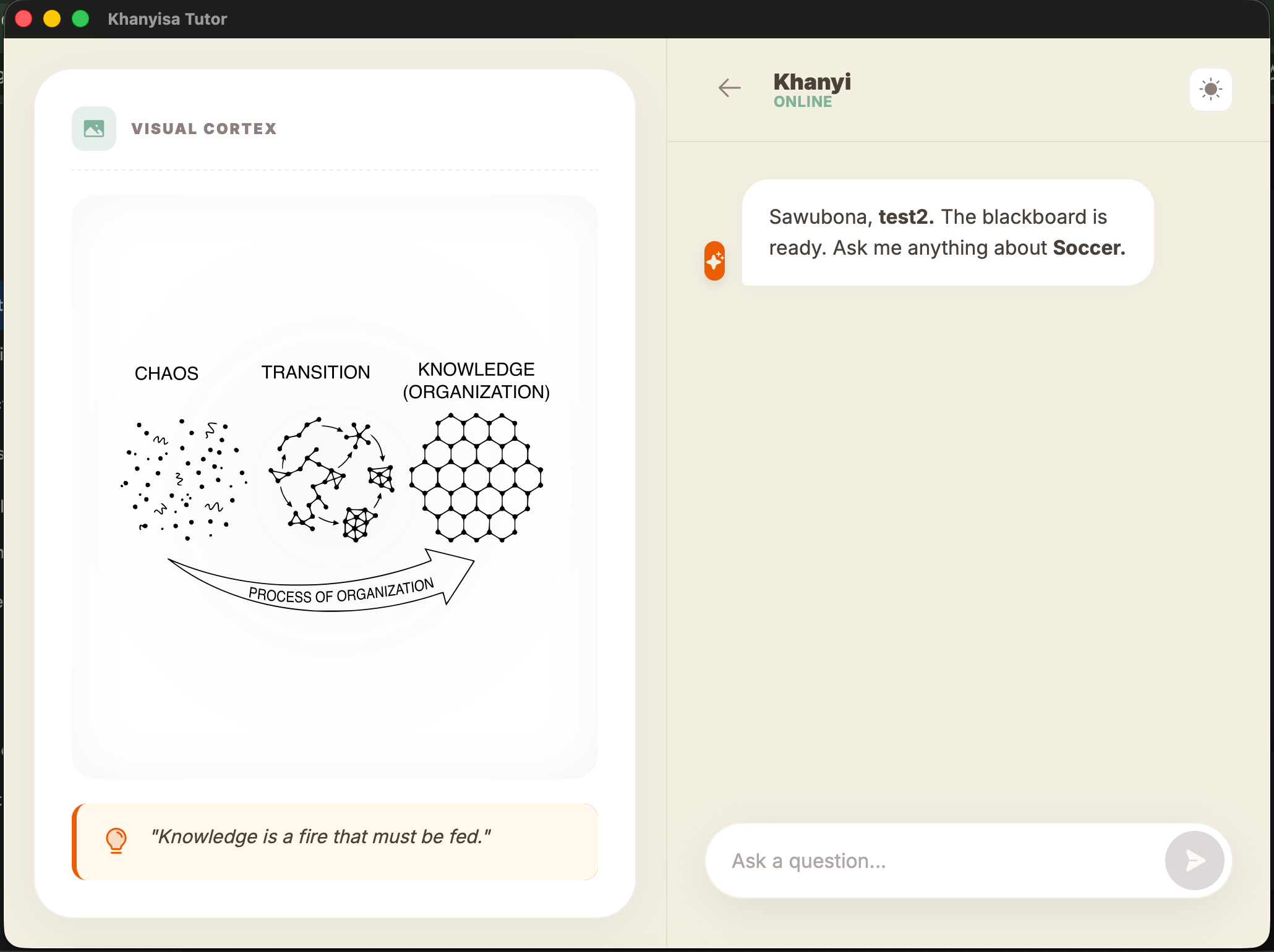
Left Pane (The Visual Cortex): This is where the AI projects images, diagrams, or “Wisdom Cards.” It is static and reference-heavy.
Right Pane (The Conversation): This is the chat interface. It is fluid and fast.
By separating them, we solve the “Scroll Problem”—where a student asks a question and the diagram disappears up the screen. Now, the knowledge stays anchored while the conversation flows.
The Garden: Metric Humanization
“Progress Bars” are corporate. They feel like a download manager.
We wanted to track learning in a way that felt organic to the Ubuntu philosophy.
We built “My Garden”.
You don’t “Level Up”; you “Cultivate.”
Your knowledge isn’t a “Score”; it’s a “Harvest.”
This is a subtle linguistic shift, but it changes the student’s relationship with the work. They aren’t grinding for points; they are growing a resource.
The Tech: State Management
Under the hood, this calmness requires rigorous engineering.
We utilize Rust-based State Machines to handle the transitions between these distinct modes (Dashboard → Chat →Library).
Because the Raspberry Pi 400 has limited GPU power, we rely on Svelte 5 Runes to surgically update only the pixels that change, ensuring the interface feels “liquid” (60fps) even on low-end hardware.
What’s Next: The Harvest
The Classroom is built. The Engine is humming. The Students are onboarded.
Next week, in Field Report 005, we will discuss the “Offline Internet”—how we are packing an entire library of knowledge into a localized vector database.
The blueprint is public. The code is sovereign.
Regarding the topic, briliant anti-feed design is truly needed.